
From declaration to accountable decision
WythinForge Scrap Control
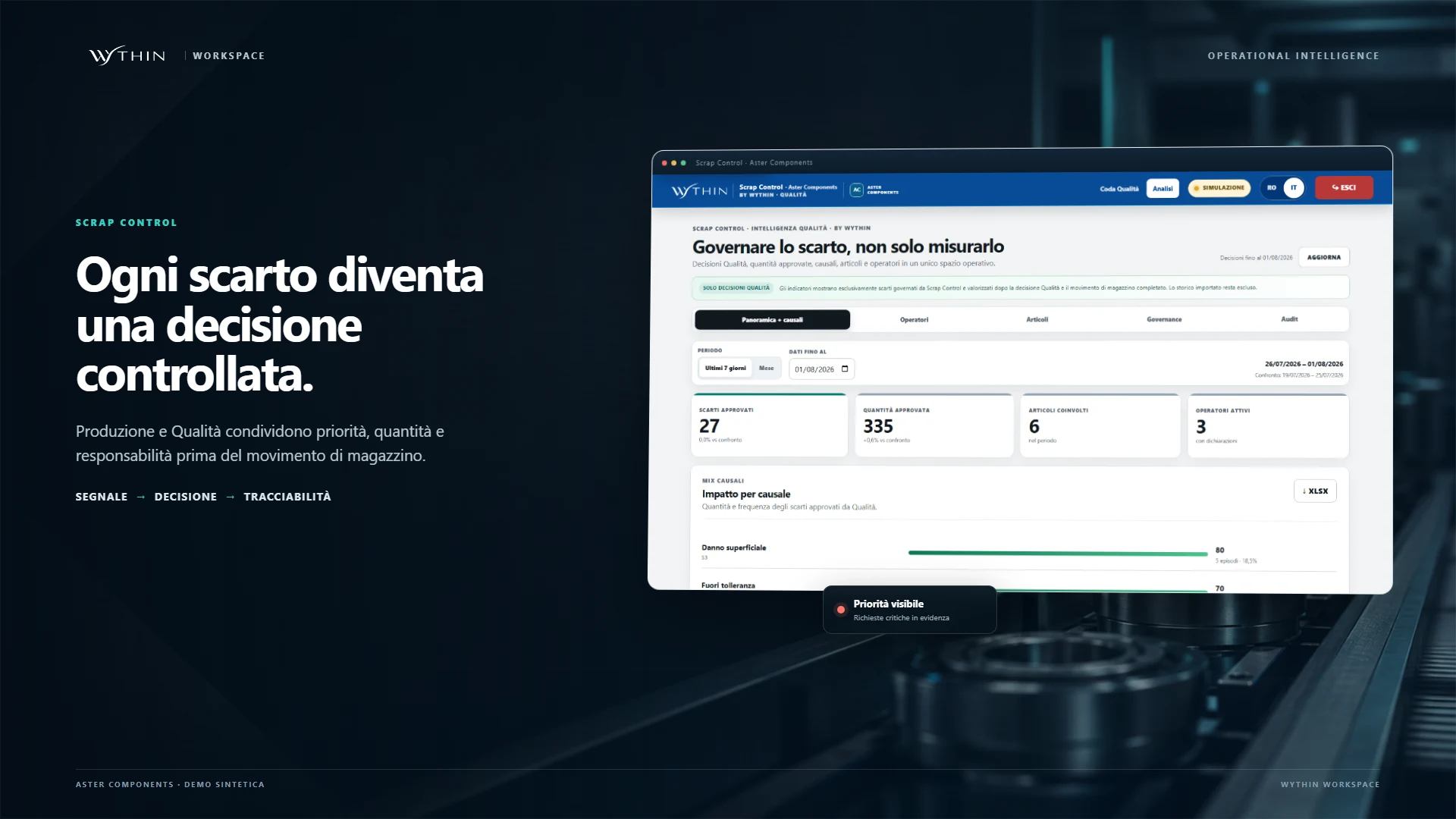
A sheet of paper used to carry the entire scrap process: item code, quantity, defect and an operator's handwriting. Scrap Control turned that fragile handoff into a guided, traceable flow inside the existing WMS process.
The story
The process lived on paper
Operators declared scrap on loose sheets: material code, quantity and the defect they had found. That paper then travelled from production to Quality, carrying information that could be incomplete, hard to read or interpreted differently from one operator to the next.
The risk was not only a transcription error. Every sheet introduced waiting, a manual handoff and another place where traceability could break.
The burden moved to Quality
Quality then had to translate the paper into the WMS. The system was essential, but it had not been designed around this exact scrap workflow: completing a declaration meant moving across interfaces, performing several actions and manually searching the application to reconstruct the history.
Then Scrap Control arrived
Scrap Control entered the existing WMS process as an intelligent operational layer. At a production station, the operator signs in with personal credentials, scans the barcodes already present on the material and completes the declaration through a short guided path. The application can suggest the most likely defect while leaving the operator in control of the choice.
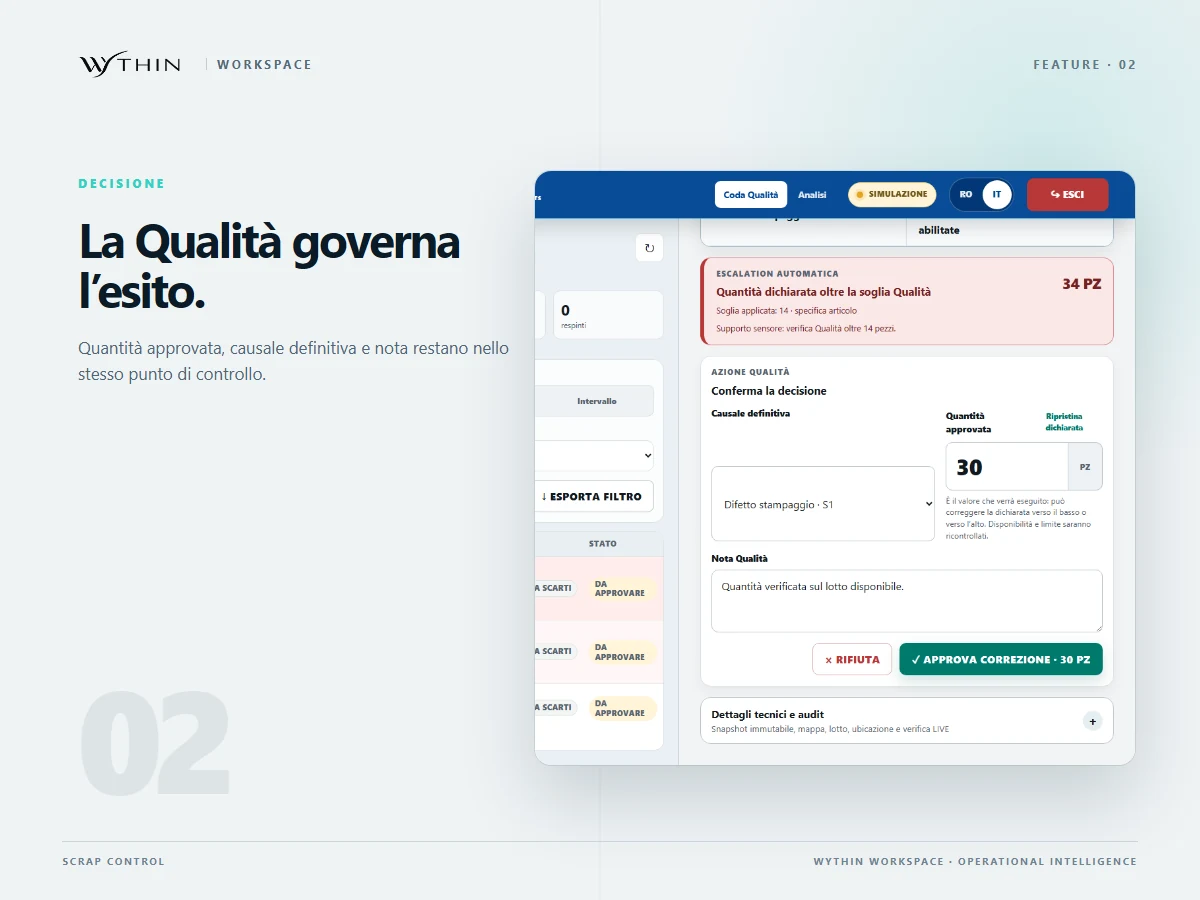
Quality sees each new declaration immediately and, with one action, can take ownership and decide how to handle it from a single queue. The WMS remains the system of record; Scrap Control orchestrates the actions needed to reach the result with less friction.
On-premise by design
The application runs on-premise, without public internet access, and operates only inside the company network. Data stays within the environment while operators receive the response speed expected from a production tool.
What happens now
Users and badges
The administrator creates accounts, assigns roles and issues badges for fast, controlled station access.
Guided operator flow
Operators declare scrap, review what they submitted and follow the status of every declaration.
Quality governance
Quality monitors priorities, approves or rejects with a reason, and analyses scrap by cause, item and operator.
The essential product evidence
Only the most useful screens are shown. Product visuals use synthetic scenarios and may preserve the original Italian interface; customer outcomes remain separate from demo values.
Bring me a scrap process to simplify